
EuPRAXIA-DN Fellow brings particle accelerator physics to life at the Victoria Gallery & Museum
EuPRAXIA-DN Fellow Ana Maria Guisao Betancur joined members of the University of Liverpool’s QUASAR Group for a vibrant outreach session at the University of Liverpool's Victoria Gallery & Museum (VG&M) on 4th August 2026. The free event welcomed school children and families, providing an engaging opportunity to discover the fascinating world of accelerator physics through fun, interactive, hands-on activities.

The programme was divided into two parts, allowing the team to adapt their engagement to different audiences. The first part was a public drop-in session, which attracted a wide range of visitors, particularly families, interested to learn about the science behind modern technology.
This was followed by an hour-long session of mini workshops for Year 6 students, who took part in small groups during the second half of the afternoon.
The team presented three different working models, each designed to make abstract scientific concepts understandable:
Imaging Outreach Demo: Ana Maria exhibited an interactive experiment exploring the principles of optics, a fundamental concept in everything from cameras to projectors. She showed how lenses focus and defocus light, with an analogy for how particle beams are focused inside accelerators. The activity helped visitors understand how precise control of beams is essential for modern accelerator science.
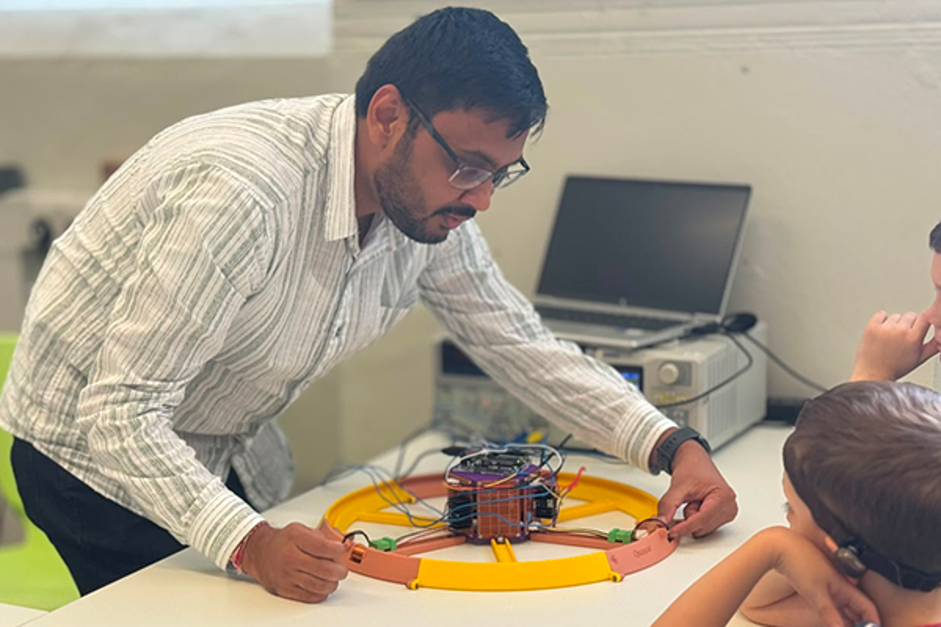
Both the "Tabletop Ball Bearing Accelerator" and the "Schlieren Imaging" activities were developed by EuPRAXIA-DN Fellows during a week-long training at the Cockcroft Institute this summer. Videos showcasing the demonstrations and underlying science can be found here (https://www.youtube.com/watch?v=gU09Tz0pCUw&list=PLfIU2WWZVrO4).

After the public session, the team hosted around 30 Year 6 schoolchildren. The students were divided into smaller groups, allowing for more focused, interactive workshops. Giving them the opportunity to explore the exhibits, ask questions and see the physics in action, the hands-on workshops helped spark their curiosity and interest in science and engineering.
This outreach event highlighted the innovative research being carried out at the University of Liverpool through EuPRAXIA-DN and the QUASAR Group and showed the importance of science communication in inspiring the next generation of scientists and engineers.


Comments